

Rage Isn’t Random
PART I: What the brain is doing long before we explode.

Rage (noun): “violent and uncontrolled anger,” “an intense feeling: passion,” and “to prevail uncontrollably.”

Sansa Stark (Sophie Turner) in Game Of Thrones (2011-2019).
Editor’s Note
After roughly 38+ hours of studying this topic, I find myself at a crossroads on how I want to approach this. I could hit the nail on the head and illustrate the psychology behind why we experience rage and how we express it. I could lean away from the neurological and biological approach and instead discuss the topic through the lens of the patriarchy, as I am a 25-year-old single female. But that doesn’t feel right either.
While conducting my research, I found myself running down rabbit holes until I was so far into the labyrinth that I didn’t what direction was up and which was down. This essay will merely be the tip of the iceberg of the conversation we desperately need to have. I could talk about this all day… so be on the lookout for parts II and III ; )
Without further ado, here is an amalgamation of my research, personal annotations, and lived experience. As always, all of my sources are listed at the end of the article, and I do recommend reading, watching, listening, and pondering them in your own due time.
For now, grab a snack or fun drink and let’s dive in!
Why We Break
PART I: EMOTION VS. FEELING
Before we delve into the dichotomies and similarities in how men and women perceive rage, we need to break down the essential parts of the brain related to emotions & feelings.
So, what is the difference between an emotion and a feeling? Think of emotions as unconscious and feelings as conscious. You are born with emotions written into your brain’s code. Think back to Inside Out. You have happiness, sadness, anger, fear, and disgust. Then you have learned emotions through social interactions, which branch off from your coded emotions. These I will list below (“Wheel of Emotions,” n.d.). Emotions are intrinsic; feelings are extrinsic. You feel emotions throughout your body on a biomechanical level. Feelings are just interpretations of your emotions, so you’re able to become conscious of them. They’re subjective. (Nicholson et al. 2017). Thus, we can label the feeling of an emotion in a multitude of ways.
Examples:
Happiness → joy, contentment, love, excitment, euphoria, acceptance, etc.
Sadness → discontentment, guilt, shame, grief, loss, lonliness, rejection, etc.
Anger → frustration, pride, rage, irritation, hate, threatened, etc.
Fear → scared, anxious, unease, embarassment, jealousy, terror, panic, etc.
Disgust → envy, dissapointment, judgmental, avoidance, etc.
Surprised → excited, amazed, confused, startled, perplexed, etc.
PART II: NEUROSCIENCE & BIOLOGY
Four parts of your brain play a quintessential role in the conversation surrounding rage.
Number 1, the Amygdala, the survival center of the brain. This is where you feel fear and anxiety. Number 2, the Limbic System, which controls your emotional circuits. This is where you process your emotions. Number 3, the Hippocampus, is in charge of processing learning, as well as storing your memories. When you learn from something, you’re learning through the emotions you experienced at that time. Number 4, the Dorsomedial Prefrontal Cortex (DmPFC) is responsible for social awareness, decision-making, and correlating emotions with actions (Nicholson et al. 2017). This is one of the most essential parts of our conversation. When it comes to rage, it’s due to us suppressing emotions and feelings over time. When we numb our emotions, we try to suppress the DmPFC; the limbic system is still active (Dr. K, HealthyGammerGG, 2025).
Dr. Alok Kanojia (2025) illustrates this perfectly. When something goes wrong, someone hurts your feelings, hurts you physically, or something triggers you, to protect you, your brain vows never to put yourself in that situation again. It is your amygdala (your survival center) protecting you from harming yourself again. Ergo, when you embarrass yourself at the gym, you don’t want to return. When you have a horrific falling out with an ex, you have trepidations about getting back into a relationship. Our behaviors are influenced by our learned emotions (Dr. K, HealthyGammerGG, 2025).
Now, let’s understand PTSD and the role it plays. When you experience something harmful and/or traumatic, your amygdala lights up and sends warning signs to the rest of your brain (“Emotion Process,” 2019). Again, your brain simply wants to protect you. How do we heal from it, you ask? This is why our brains have an emotional processing center and why it’s essential we understand the value of it. If we did not have access to an organ in charge of separating our emotions, they would take over and program us more than they already are (Dr. K, HealthyGammerGG, 2025).
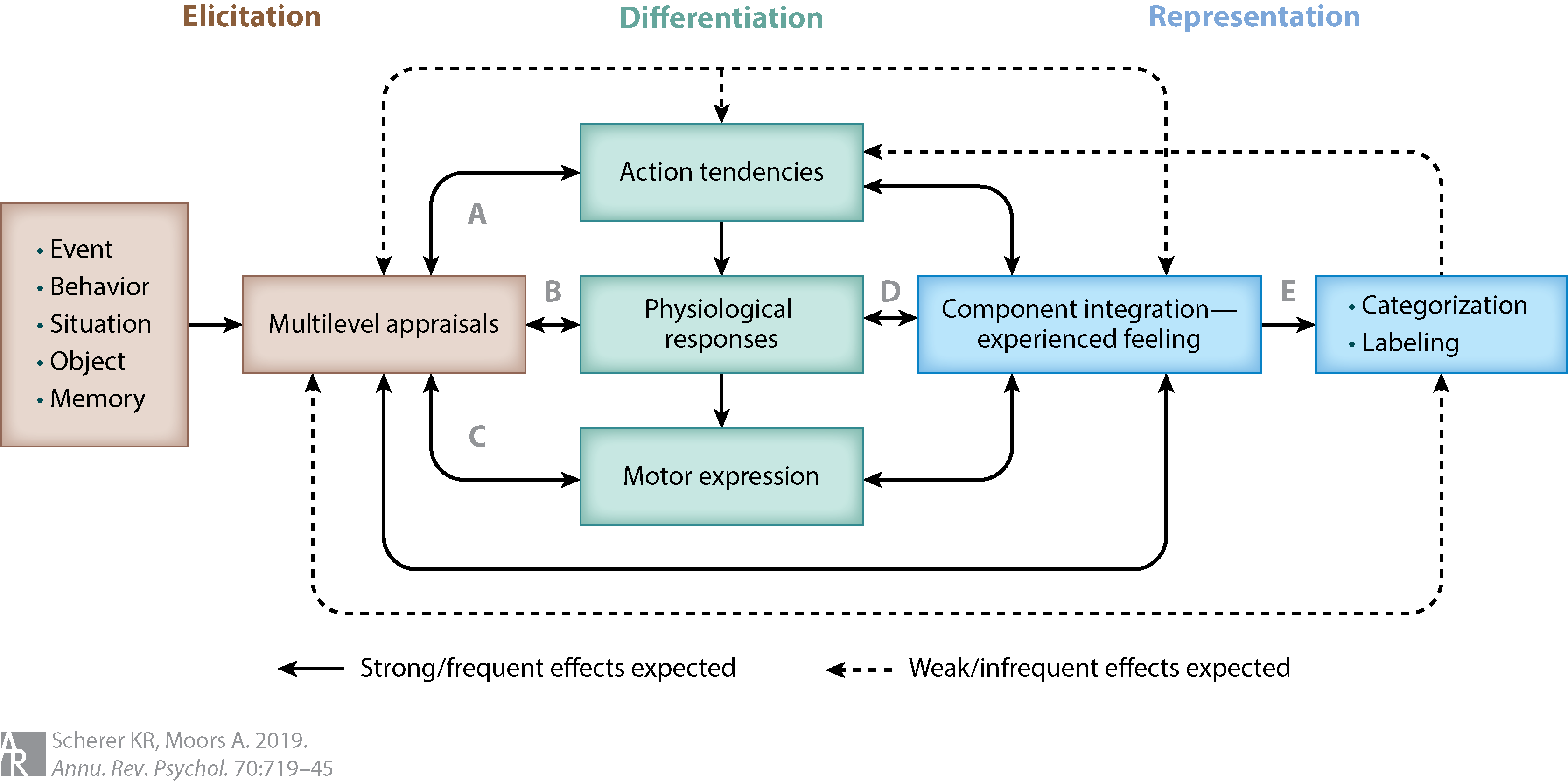
Nicholson et al. 2017
The image above illustrates how our emotional processing system works. In simplest terms: think of elicitation as the collection of information being sent to our hippocampus, differentiation is how this information is processed, and representation is how we choose to respond to it (“Emotion Process,” 2019). Examples of elicitation triggers can come from an array of options, either internal or external.
Internal: One or multiple of our five senses, imagination, memories, hormonal changes, substances, etc.
External: The behaviors and actions from others and ourselves, mother nature, the economy, government, social media, etc.
Differentiation is where people tend to ‘spiral’. “Why did they say that?” “Did I do something wrong or upset them?” “Do they hate me?” “How can I fix this?” and so on. The process from differentiation to representation is where your motor expressions will kick in while pondering these. Scrunching your nose, lifting and lowering your eyebrows, squinting or widening your eyes, the ‘hairs raising on the back of your neck’, etc. Representation, as seen in the image above, is the labeling stage. Labeling how the triggers and experiences we’re facing make us feel. Angry, frustrated, calm, aroused, cautious, excited, to name a few (“Emotion Process,” 2019).
PART III: FROM INTELLECTUALIZING TO RESPONSE
Now let’s tie it all in. The fact of the matter is, we all, at some point in our lives, have experienced something that made us suppress our emotions. Triggers for these situations could result from physical or emotional abuse, including but not limited to: sexual assault, death or threatened death, beating, burning, shaking, situations where parents belittle their children, name call, belittle them, adopt hostile attitudes/behaviors, hold unrealistic expectations, neglect, and extreme exposure to traumatic events (Kılıç et al. 2024).
We now know that when we numb our emotions, we try to suppress the DmPFC; however, the limbic system remains active. So, how does this affect us, you ask? Well, it’s one giant pipeline. One never-ending domino effect. When you suppress your emotions instead of dealing with them and facing them, you never heal from them. You distract yourself from the process of healing so you don’t have to face the pain of the situation again. Deep breath in, SO, since your limbic system remains active, your emotional circuits are still running without a way to process them (Dr. K, HealthyGammerGG, 2025).
Picture it like gears running on overdrive at 80mph; you’re not applying more grease to lubricate them. Eventually, the gears will grind together due to friction, pressure, and grime buildup, and the gears will break. Well, guess what, our brains work the same way. With all of those emotions and trauma you’ve suppressed, eventually your gears are going to blow apart.
To Be Continued…
As I stated in my intro, this is just the tip of the iceberg of a conversation our society needs to have. Before we can discuss the dichotomies and similarities in male and female rage, we must first understand how we arrive at rage in the first place. Part II will cover the sooner and the cost of suppressing our emotions. Follow for parts II and III, and I’ll see you soon ;)
Sources:
The collection for all three of my essays on rage.
Alok Kanojia (Dr. K), “An Honest Talk About Male Pressure & Depression ft. Dr. Zac Seidler,” November 8, 2025, in HealthyGamerGG, produced by Healthy Gamer LLC, podcast, 2:17:19
Alok Kanojia (Dr. K), “Why Men Keep Losing Control.” September 8, 2025, in HealthyGamerGG, produced by Healthy Gamer LLC, podcast, 01:44:37.
Alok Kanojia (Dr. K), “Why Modern Men Feel Empty,” November 1, 2025, in HealthyGamerGG, produced by Healthy Gamer LLC, podcast, 00:29:00.
Centers for Disease Control and Prevention. “Fast Facts: Preventing Child Abuse & Neglect.” Last modified 2022. Accessed February 29, 2024.
Emotional Processing Theory: An Update. In Pathological Anxiety: Emotional Processing in Etiology and Treatment, edited by Barbara Olasov Rothbaum. 2006.
Estés, Clarissa Pinkola. 1992. Women Who Run With the Wolves: Myths and Stories of the Wild Woman Archetype.
Gabor Maté. “How to Process Your Anger and Rage.” The Tim Ferriss Show, September 7, 2022. YouTube video.
Harvard Health Publishing. “The Nature of Anger.” Harvard Health, January 16, 2024.
Hoffman, Bruce, Jacob Ware, and Ezra Shapiro. 2020. “Assessing the Threat of Incel Violence.” Studies in Conflict & Terrorism 43 (7): 565–87. doi:10.1080/1057610X.2020.1751459.
Kılıç, Bengü Sare Sevda Pelin, Seren Saltoğlu, and Emel Erdoğdu. “Effects of Early Psychological Trauma on Limbic System Structure and Function.” DergiPark, December 25, 2024.
“Matthew McConaughey — The Art of Living a Courageous Life,” September 29, 2025, Modern Wisdom, podcast, 01:57:45.
Mel Robbins. “Dr. Gabor Maté: The Shocking Link Between ADHD, Addiction, Autoimmune Diseases, & Trauma.” The Mel Robbins Podcast, November 21, 2024. Podcast audio.
Moors, A. 2017. The integrated theory of emotional behavior follows a radically goal-directed approach. Psychol. Inq. 28(1):68–75
Nicholson, Andrew A et al. “The neurobiology of emotion regulation in posttraumatic stress disorder: Amygdala downregulation via real-time fMRI neurofeedback.” Human brain mapping vol. 38,1 (January 2017): 541-560. doi:10.1002/hbm.23402
Rachel Allyn, Ph.D., “The Important Difference Between Emotions and Feelings: Understanding this distinction is crucial to healthy coping”. February 23, 2022.
Ryan Martin. “Why We Get Mad — and Why It’s Healthy.” TED Talk, 2019. Video, 13:07.
The Emotion Process: Event Appraisal and Component Differentiation. Annual Review of Psychology 70 (2019): 719–745. https://doi.org/10.1146/annurev-psych-122216-011854
“Wheel of Emotions Handout.” Illinois State University Counseling & Testing Center. Accessed December 10, 2025.
Waiting for 2nd part🐣
Thankyou for writing this! We need more people discussing this